
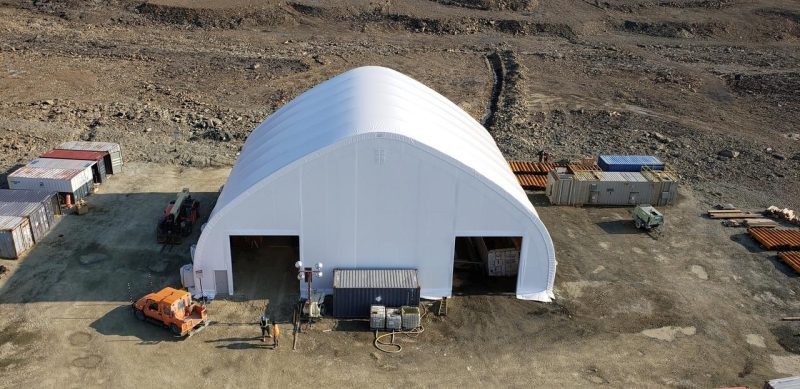
When you’re scoping a temporary or semi-permanent structure for a remote mining operation, the choice between a canvas building and a conventional steel structure is a question of fit. Both have legitimate engineering behind them. What differs is how each performs against the specific constraints of remote site work: mobilization timelines, foundation requirements, capital classification, and what happens to the asset when the project winds down.
Here’s a direct look at where each structure wins, and where it doesn’t.
Total Cost of Ownership, Not Just Purchase Price
The upfront delta between a canvas building and a pre-engineered steel building is significant; canvas structures typically come in at a fraction of the capital cost. But the more relevant number for remote operations is total cost of ownership across the project lifecycle.
Steel buildings require engineered concrete foundations, which on a remote site means mobilizing concrete equipment, managing cure timelines in variable temperatures, and absorbing costs that are entirely site-specific. In northern or fly-in/fly-out operations, that foundation work can represent a substantial portion of the total building budget before a single structural member goes up.
Canvas buildings, particularly engineered truss designs, can be mounted on rig matting, screw anchors, concrete blocks, or shipping containers. For operations already managing matting logistics on site, this can effectively reduce the foundation cost to near zero. That changes the TCO calculation considerably.
At project close, the math shifts again. A poured foundation is a sunk cost. A canvas building is a relocatable asset.
Capital Classification and Asset Mobility
This is often the deciding factor for finance teams. A permanent steel structure with a poured foundation is a fixed asset — it stays with the land. In a lease, joint venture, or exploration context where site tenure is uncertain, that’s a liability embedded in the build decision.
Canvas buildings can be classified differently depending on jurisdiction and structure type, and their portability means residual value is retained. When a project moves into a new phase, scales down, or closes, the building relocates with the operation rather than being written off or negotiated into a land transfer.
For project managers working within capital approval frameworks, the ability to reallocate the asset, or propose it as an operating rather than capital expense depending on configuration, has real budget implications worth raising with your finance lead early.
Mobilization and Erection Timelines
Remote sites operate on compressed schedules. A conventional steel building requires detailed fabrication lead times, sequenced delivery of heavy structural components, and a skilled steel erection crew. Depending on site access, that crew may require fly-in, camp accommodation, and extended mobilization.
Canvas buildings are engineered truss systems manufactured to spec and shipped as complete packages. Erection crews are smaller, the process is faster, and because no foundation pour is required, the critical path is shorter.
If your project schedule is pressure-tested, weeks matter. Canvas buildings close that gap.
Operational Performance in Northern Environments
Canvas buildings are not unheated tents. Engineered fabric structures can be fully insulated, heated, lit, and ventilated; the same amenity set as a permanent structure, at lower cost and with faster deployment. The fabric itself transmits up to 80% of natural light during daylight hours, which reduces lighting load during operating hours and matters on sites without reliable power infrastructure.
Where steel buildings have an edge is in long-term thermal performance for heated spaces and in applications requiring overhead crane systems with significant load ratings. If your maintenance shop requires a 20-ton overhead crane, a purpose-built steel structure is likely the right answer. For equipment storage, maintenance bays with lighter lifts, parts storage, dry storage, or administrative use on remote sites, canvas performs well at substantially lower cost.
When Steel Still Wins
Canvas buildings aren’t the answer for every application. Steel is the right call when:
- Heavy overhead crane requirements — high-tonnage crane systems require the structural rigidity of steel frames.
- Multi-storey or complex interior configurations — canvas buildings are single-storey clear-span structures. That covers a wide range of applications, but not all of them.
The Decision Framework
For most remote mining applications, equipment laydown, maintenance facilities, parts and materials storage, dry storage, generator or compressor enclosures, the decision should start with canvas and work backwards to steel only if there’s a specific requirement that fabric structures can’t meet.
The reasons are practical: faster deployment, lower foundation cost, retained asset value, and meaningful capital savings that can be redirected into productive project spend. When the engineering is properly specified and the supplier has documented experience in remote industrial deployment, canvas buildings carry none of the risk premium that some project teams assume.
If you’re scoping a structure for an upcoming phase and want to pressure-test the build options against your specific site conditions, FastCover’s team works directly with project managers through the specification process.
Contact FastCover to discuss your site requirements →
FastCover Buildings has been supplying and installing fabric structures across mining, oil & gas, agriculture, and industrial sectors for over three decades. Structures are fully engineered, manufactured in-house in Winnipeg, Manitoba, and backed by a 15-year prorated warranty.