
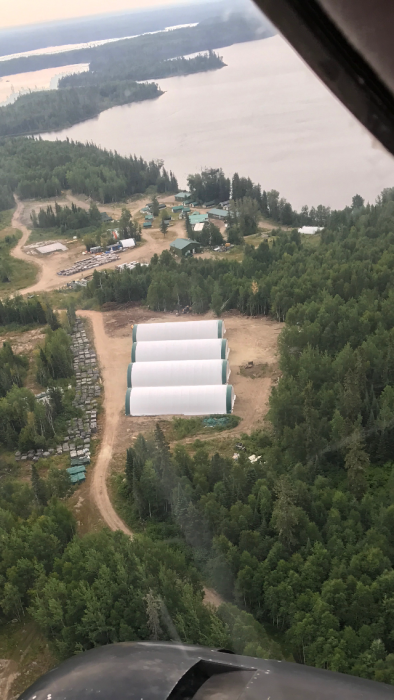
Mining operations don’t pause for weather—or location. The industry requires adaptable infrastructure that can be deployed quickly, perform reliably, and evolve with the demands of the project. Fabric buildings have emerged as one of the most practical and versatile solutions for today’s mining companies.
This article explores real-world applications for fabric buildings across the mining lifecycle—from exploration and extraction to processing and equipment maintenance.
-
Core Sample Storage: Protecting Data That Drives Decisions
During exploration, every core sample collected represents valuable geological data. These samples need to be stored in a clean, dry, and temperature-controlled space—especially in harsh climates.
Why fabric buildings work:
Fabric structures can be rapidly deployed near drill sites and customized with insulation, lighting, and shelving. Their clear-span interiors make it easy to organize and access samples, while protecting them from rain, UV exposure, and fluctuating temperatures that can compromise results.
-
Equipment Storage and Maintenance Bays: Keeping Machines Running
Mining equipment is a massive investment—and keeping it protected and operational is critical to staying productive. Whether you’re storing haul trucks, loaders, conveyors, or processing equipment, you need a reliable shelter that can handle the job.
Why fabric buildings work:
Their high clearances and wide-span designs accommodate large vehicles and equipment with ease. Add doors, ventilation, and lighting, and these structures become ideal spaces for routine maintenance or emergency repairs—without the cost or timeline of traditional buildings.
-
Mobile Workspaces and Break Areas: Supporting Your Crew
Mining camps and temporary sites require quick-to-install structures for crew facilities. These can range from lunchrooms and locker areas to mobile offices and safety briefings stations.
Why fabric buildings work:
Because they’re modular and relocatable, fabric buildings can move with your project. They’re also fast to set up and highly customizable—allowing you to add insulation, vents, and partitions based on crew size and environmental needs.
-
Bulk Material Storage: From Ores to Aggregates
Operations that process and transport raw materials like ore, gravel, or tailings need covered storage areas to minimize moisture exposure and material loss.
Why fabric buildings work:
Fabric structures provide weather-tight protection while allowing easy access for loaders, trucks, and conveyors. Their open interior space makes them ideal for housing bulk materials while minimizing contamination or runoff.
-
Processing Facilities: A Scalable Option for Expanding Operations
As a mine site scales, new processing areas may be needed—whether for crushing, screening, or washing. Constructing a permanent facility can take months and eat up capital.
Why fabric buildings work:
These buildings can be custom-designed with the height and access points needed for conveyors, chutes, and processing machinery. The modular design easily allows you to expand to virtually any length as operations grow, making it easy to scale up your processing capacity.
-
Harsh Environments: Surviving Snow, Wind, and Chemical Exposure
Many mine sites experience extreme weather or environmental conditions—ranging from high winds and snow loads to chemically corrosive dust or moisture.
Why fabric buildings work:
Quality FastCover fabric structures are engineered to meet local building codes and can be designed to handle high wind speeds and heavy snow loads. Powder-coated steel components resist rust and corrosion, which is especially important near processing plants or tailings ponds.
Why More Mining Companies Are Making the Shift
Fabric buildings offer mining companies a powerful combination of speed, flexibility, and cost control—especially in remote or fast-changing environments. They’re not only faster to deploy than traditional structures, but they can also be reconfigured or relocated as your site evolves.
Whether you need a temporary solution or a long-term asset, fabric buildings have proven their value across a wide range of mining applications.
Need a structure for your next mining project?
Ask us how a custom-engineered fabric building can solve your site’s unique infrastructure challenges—without slowing down your operation.